The Roberts Court transformed the debate over presidential removal with two conflicting cases. In Trump v. Slaughter, the Court overruled Humphrey’s Executor and embraced a maximalist unitary executive. It rejected the “quasi-judicial” and “quasi-legislative” categories from Humphrey’s that were the foundation for independent regulatory commissions. But in Trump v. Cook, the Court preserved removal protections for Federal Reserve Governors and emphasized the distinctive history of monetary administration. Commentators agreed that the two opinions were in tension. Slaughter may have ended the Humphrey’s paradigm, but Cook suggests that some of that older world may have survived.
This Article illuminates the distance between Slaughter and Cook by recovering a tradition of quasi-judicial administration from seventeenth-century England to the New Deal. Lawmakers throughout American history have grafted judge-like norms, processes, and procedures onto modes of administration that performed judge-like functions or handled sensitive money-related tasks. At the same time, lawmakers worked to shield many quasi-judicial administrators from hierarchical political control with a variety of tools: removal restrictions, fixed terms, multimember decision making structures, and many other devices. Our point is not that all quasi-judicial administrators must be independent. Instead, our claim focuses on a robust history of Congress wielding broad discretion to decide when and where to create insulated judge-like administrators. The lost tradition we describe is the missing link in explaining Wiener v. United States and making sense of the result in Cook. And that same tradition gives us one of the strongest repudiations of the unitary executive theory.
The full text of this Article can be found by clicking the PDF link to the left.
* Associate Professor, University of Utah S.J. Quinney College of Law.
** Professor of Law and Harry Elwood Warren Scholar, Boston University School of Law. We thank Emily Bremer, Christine Chabot, Benjamin Dinovelli, Nathaniel Donahue, Andrea Scoseria Katz, Jane Manners, Gillian Metzger, Lev Menand, Victoria Nourse, Nicholas Parrillo, Daniel Rodriguez, and Noah Rosenblum; and Lucio Maffei and Ethan Williams for excellent research assistance. No artificial intelligence was used for this research or writing, other than Word’s basic spell check and grammar check.
“When an agency ‘executes’ a congressional mandate against private parties, it exercises executive power—no ifs, ands, or quasis about it.”
— Chief Justice John Roberts, Trump v. Slaughter1
146 S. Ct. 2283, 2302 (2026).
“It [is] necessary . . . to consider the nature of this [Comptroller of the Treasury] office . . . ; in analyzing its properties, we shall easily discover they are not purely of an Executive nature. It seems to me that they partake of a Judiciary quality as well as Executive; perhaps the latter obtains in the greatest degree . . . . [A] modification by the Legislature may take place in such as partake of the judicial qualities, and that the legislative power is sufficient to establish this office on such a footing as to answer the purposes for which it is prescribed.”
— James Madison, 1789
2
1 Annals of Cong. 611–12 (1789) (Joseph Gales ed., 1834) (statement of Rep. Madison) (emphasis added)
“I do not consider myself as the advocate of the government, but as a judge called to decide a question of law with the impartiality and integrity which characterizes the judician. I should consider myself as dishonoring the high-minded government, whose officer I am, in permitting my judgment to be warped in deciding any question officially by the one-sided artifice of the professional advocate.”
— Attorney General William Wirt, 1820
3
Letter from William Wirt to John C. Calhoun (Feb. 3, 1820) (on file with Nat’l Archives, Rec. Grp. 60, General Records of the Department of Justice, General and Miscellaneous Letter Books, 1818–1913, vol. A2, at 67, 68), https://catalog.archives.gov/id/ 72689150?objectPage=71 [https://perma.cc/W6NE-TP86] (emphasis added).
Introduction
The Roberts Court has now done what most experts expected and many feared. In Trump v. Slaughter,
4
146 S. Ct. at 2294.
the Court embraced what one of us has called the “maximalist” Unitary Executive Theory (UET).
5
Beau Baumann, It’s Taft’s Nightmare, Passing Political Time (Dec. 12, 2025), https://bbaumann.substack.com/p/its-tafts-nightmare [https://perma.cc/T2DE-BE8X] [hereinafter Baumann, Taft’s Nightmare]. The maximalist UET is a reading of Article II that demolishes any clear limitations on presidential control over the administrative state. See id. For a defense of the maximalist UET, see generally Adrian Vermeule, What Is “The Unitary Executive”?, New Digest (May 22, 2025), https://thenewdigest.substack.com/p/what-does-the-unitary-executive-mean [https://perma.cc/RB4G-UMJ9].
The unitarian majority overruled Humphrey’s Executor,
6
295 U.S. 602 (1935).
in the process depriving so-called independent regulatory commissions of their constitutional foundation.
7Slaughter, 146 S. Ct. at 2302 (“If anything more is left of Humphrey’s, we overrule it.” (emphasis omitted)).
The Slaughter holding allows the President to remove Federal Trade Commissioners at will.
8
Id. at 2291. Slaughter rejected the idea that Congress may insulate modern agencies from presidential removal by calling their work quasi-legislative or quasi-judicial.
9
Id. at 2302.
The author of the majority opinion, Chief Justice John Roberts, treated these as the commands of the Constitution.
10
Id. at 2292–95; see also Beau J. Baumann, The Case Against the Unitary Past: Seven Opinions on Legal History and the Unitary Presidency 9–15 (2026) (unpublished manuscript) (on file with the Columbia Law Review) (discussing and deconstructing one approach to legal history that treats the past as a series of inviolable commands operating on the present); Andrea Scoseria Katz & Jane Manners, “Lost to History”: Uses and Abuses of the Past in Slaughter and Cook, Just Sec. (July 10, 2026), https://www.justsecurity.org/145132/lost-history-slaugther-cook-scotus/ [https://perma.cc/SC6V-722N] (“Confronted with a historical record that does not support its theory, the Court presents clear-cut answers where the sources supply none and disregards or ignores evidence that cuts the other way. The result is a folk history whose myths point in only one interpretive direction.”).
But on the same day, another Roberts-authored opinion refused to abide by Slaughter’s vision. In Trump v. Cook, the Court refused President Trump’s attempt to remove Federal Reserve Governor Lisa Cook.
11
146 S. Ct. 2234, 2246 (2026).
If history was a set of clear commands in Slaughter, things were more complicated, more nuanced, once the Court trained its gaze on the Federal Reserve system. Roberts treated monetary administration as historically distinctive.
12
See id. at 2249 (“For present purposes, it is sufficient to observe that any definition of ‘cause’ in this context must reflect the Federal Reserve’s unique historical status and role.”).
The long history of monetary policy in America required greater respect for insulated administration (never mind Roberts’s maximalist reading of the text of Article II in Slaughter).
13
See id. at 2246 (“To accept any one of those arguments would in effect transform the Federal Reserve’s for-cause protection into at-will employment—an interpretive leap out of step with the statute Congress enacted and our Nation’s tradition of central banking protected from political interference.”); Slaughter, 146 S. Ct. at 2334 (Sotomayor, J., dissenting) (criticizing the majority’s “radical theory of unitary executive power”).
Experts’ reception of the twin opinions in Slaughter and Cook was embodied in a bit of gallows humor. One law professor’s joke started spreading the same day that the opinions were handed down: “I hope the guy who wrote Slaughter doesn’t run into the guy who wrote Cook. That would be a really rough conversation.”
14
Adam Liptak, Supreme Court Turbocharges Presidential Power, N.Y. Times (July 23, 2026), https://www.nytimes.com/2026/07/23/us/politics/the-docket-presidential-power-trump.html (on file with the Columbia Law Review) (emphasis added) (internal quotation marks omitted).
The same sentiment was echoed by Professor Lev Menand, who wrote that the opinions “read like they had been written by two different people.”
15
Lev Menand, The Federal Reserve Exception to the Slaughter Rule, Just Sec. (July 7, 2026), https://www.justsecurity.org/145707/slaughter-categorical-rule-cook-exception/ [https://perma.cc/56Y6-WXLN] [hereinafter Menand, Fed Exception].
People who agree on little else on questions related to the UET could at least find common ground on the idea that Slaughter and Cook lacked a unifying rationale or approach to legal history.
16
See, e.g., Cook, 146 S. Ct. at 2281 (Barrett, J., dissenting) (“[T]he Court’s holding is in serious tension with Trump v. Slaughter . . . .”); id. at 2274 (Thomas, J., dissenting) (writing that the majority “endorses a contradiction”); Zack Beauchamp, Trump’s Quest for Untrammeled Power Just Got a Big Boost, Vox (June 30, 2026), https://www.vox.com/policy/493735/trump-power-agencies-slaughter-supreme-court [https://perma.cc/9HRM-YVA9] (“The rulings do not make sense together unless you see Cook less as law than policy.”); David Dayen, Two Rulings that Are Impossible to Reconcile, Am. Prospect (June 29, 2026), https://prospect.org/2026/06/29/supreme-court-two-rulings-impossible-to-reconcile/ [https://perma.cc/SXJ9-GZ2E] (“There is no way to hold the two rulings together at once.”); Dan McLaughlin, Chief Justice Roberts Tries to Save the Fed From Democracy and the Constitution, Nat’l Rev. (June 29, 2026), https://www.nationalreview.com/2026/06/chief-justice-roberts-tries-to-save-the-fed-from-democracy-and-the-constitution/ (on file with the Columbia Law Review) (arguing that the history of monetary administration in Cook could not exempt the Fed from the reading of Article II in Slaughter); Ilya Somin, Can the Supreme Court Slaughter Slaughter Without Cooking Cook?, Reason: Volokh Conspiracy (June 29, 2026), https://reason.com/volokh/2026/06/29/can-the-supreme-court-slaughter-slaughter-without-cooking-cook/ [https://perma.cc/KX5W-N7VV] (“It seems to me highly likely, though not certain, that the answer is ‘no.’”).
Like much of the constitutional adjudication that occurs at One First Street, the Roberts Court’s actions in these cases are made more legible by understanding the stories that guided the Justices.
While today we see Humphrey’s Executor as the bane of the conservative legal movement and a key ballast of the New Deal order, many New Dealers themselves attacked the decision because they shared an ideological commitment to presidential power with the Roberts Court conservatives.
17
See Beau J. Baumann, Remembering Congress in the Myers-to-Humphrey’s Interregnum, 175 U. Pa. L. Rev. (forthcoming 2027) (manuscript at 8), https://ssrn.com/abstract=5376943 [https://perma.cc/VX3M-K4XZ] [hereinafter Baumann, Remembering Congress].
They constructed a narrative that the quasi-judicial and quasi-legislative categories were creatures of judicial activism made up in the moment to frustrate President Roosevelt’s New Deal program.
18
For a powerful example of this New Deal narrative, see Robert E. Cushman, The Independent Regulatory Commissions 8 (1941) (“The use of the term ‘quasi,’ for which the best synonym is ‘not exactly,’ is a confession of vagueness, an announcement that precise definition is impossible.”).
Ironically, the New Dealers handed that narrative of judicial activism to the earliest generations of the conservative legal movement.
19
Baumann, Remembering Congress, supra note 17 (manuscript at 8); see also In re Aiken County, 645 F.3d 428, 441–42 (D.C. Cir. 2011) (Kavanaugh, J., concurring) (“Humphrey’s Executor is perhaps best explained by the fact that it was decided in 1935 on what became known as Roosevelt’s ‘Black Monday.’ It was one in a line of decisions issued . . . by a Supreme Court seemingly bent on resisting President Roosevelt and his New Deal policies.” (emphasis added)).
The New Dealers’ story forms the Roberts Court’s collective memory of Humphrey’s and guides its vindication of the UET.
20
See Baumann, Remembering Congress, supra note 17 (manuscript at 8–9). On collective or constitutional memory, see also Jack M. Balkin, Memory and Authority: The Uses of History in Constitutional Interpretation 6 (2024) (discussing the normative implications that flow from the use of constitutional memory to surmise constitutional meaning); Reva B. Siegel, The Politics of Constitutional Memory, 20 Geo. J.L. & Pub. Pol’y 19, 21 & n.5 (2022) (“We could describe constitutional memory as a form of collective memory forged through constitutional interpretation.”); Jed Handelsman Shugerman & Zachary Shugerman Handelsman, Memory Warriors, Pluralists, and Abnegators: An Essay on Pluralist Originalism in Jack Balkin’s Memory and Authority, 13 Tex. A&M L. Rev. 609, 620– 21 (2026) (labeling Unitary Executive Theorists “Right-Wing Legal Memory Warriors” and discussing how their myopic view of history has enabled the Roberts Court to expand and insulate presidential removal power).
Lured by a folk narrative about the past, the Justices of the Roberts Court have worked themselves into a dangerous position. A maximalist UET erases nuance and works pure a vision of the state as the manifestation of one person’s will.
21
See Baumann, Taft’s Nightmare, supra note 5 (noting that many conservative legalists have attempted to contain the UET precisely because its maximalist pretensions would create a state that “is the embodiment of one man’s will”).
In the Slaughter oral arguments, even the pro-presidentialist Justices asked anxious questions about how far the UET might go, searching in vain for some limiting principle that would save adjudicatory administrators and Article I judges.
22
See, e.g., Transcript of Oral Argument at 17, Trump v. Slaughter, 146 S. Ct. 2283 (2026) (No. 25-332), 2025 WL 3542394 (Kavanaugh, J.) (asking what could save the Federal Reserve system from the logic of the UET); id. at 18 (Kagan, J.) (“I think the question that these questions go to, right, is, if you take your logic at face value, it seems to include a great many things.”); see also id. at 14–15 (Sotomayor, J.) (questioning whether the logic of the UET “could be limited”). Because the critics of the Hughes Court were mostly New Dealers, see supra note 19 and accompanying text, this new historical understanding is filled with irony. By developing a narrative that delegitimized Humphrey’s Executor, the New Dealers provided a warrant that would later be seized upon by the conservative legal movement to destabilize much that the New Dealers had accomplished.
But the majority opinion in Slaughter did not engage with the significant originalist literature deconstructing the UET.
23
See Slaughter, 146 S. Ct. at 2327–29 (Sotomayor, J., dissenting) (citing to the work of numerous originalist scholars that the majority failed to engage with when endorsing the UET); Katz & Manners, supra note 10 (explaining why Founding Era history is not a “ringing . . . endorsement of the Unitary Executive Theory”).
And the Court warped the historical record even further in Cook in an effort to justify a carve-out for the Fed.
24
Menand, Fed Exception, supra note 15.
Chief Justice Roberts’s reliance on a gerrymandered historical precedent—the First and Second Banks of the United States—collapses upon scrutiny of the sources he cited.
25
See, e.g., Trump v. Cook, 146 S. Ct. 2234, 2254 (2026) (fighting off dissenting Justices by emphasizing the First and Second Banks of the United States). This emphasis on the Banks of the United States channels scholarship from Professors Aditya Bamzai, Aaron Nielson, and Daniel Tarullo. See Aditya Bamzai & Aaron L. Nielson, Article II and the Federal Reserve, 109 Cornell L. Rev. 843, 851–52 (2024) (arguing that the Banks of the United States suggest a Fed exception to the UET so long as the Fed “does not take on regulatory powers attenuated from its monetary functions”); Daniel K. Tarullo, The Federal Reserve and the Constitution, 97 S. Cal. L. Rev. 1, 68–81 (2024) (similarly drawing on the Banks to flesh out a Fed exception). But the comparison between the Fed and the Banks of the United States has been pilloried by experts in the history of banking in the United States. See, e.g., Lev Menand, The Unitary Executive and the Federal Reserve, 94 Fordham L. Rev. 2089, 2094 (2026) [hereinafter Menand, UET and the Fed] (“The Historical Practice Exception route does not work because nothing like the Federal Reserve Board existed at the founding. The oft-invoked First Bank is no precedent for limits on the president’s power to remove Federal Reserve Board members because the First Bank was not part of the government.”). And even Bamzai and Nielson did not think the Banks of the United States could save the entire Fed from the UET’s clutches. See Bamzai & Nielson, supra, at 908 (“[B]ecause at least some of the Fed’s activities go beyond those of the First and Second Banks, there is a significant argument under Seila Law and Collins that the President can remove the Fed chair, . . . Board of Governors, and perhaps others . . . involved in the Fed’s quintessential regulatory functions.”). So the Court’s opinion in Cook is inexplicable even with the conservative originalist scholarship it drew upon.
Indeed, citing an earlier version of this Article, Justice Sonia Sotomayor accused her colleagues of “feign[ing] ignorance” to reach their preferred result.
26Slaughter, 146 S. Ct. at 2343 (Sotomayor, J., dissenting).
The “quasi-judicial” category is not the problem. It is the solution, just as it has been a traditional concept and strategy in England and America for over four centuries.
27
See infra Parts II–III.
In response, this Article provides the history the Court neglected to provide us in this new post-Slaughter world. Contrary to Chief Justice Roberts’s assertion “no ifs, ands, or quasis,”
28Slaughter, 146 S. Ct. at 2302.
throughout history England and the United States had scores of quasi-judicial officers enforcing legislation and regulating private parties.
29
See infra Parts II–III.
These officers were assigned judge-like duties, norms, and procedures—and often enjoyed protections from removal and other forms of structural independence to insulate them from hierarchical control.
30
See infra Parts II–III.
We do not argue that all quasi-judicial administrators must be independent, that most such officials were insulated from removal, or that every historical example fits into a single constitutional category. The historical record is messy. It contains variation, experimentation, contradicting trends, and shifting approaches back and forth. But that messiness is a problem for maximalist and exclusivist theories of presidential control, not for our historical explanations.
31
See, e.g., Baumann, Taft’s Nightmare, supra note 5 (“That meme understanding of the presidency is now central to the case law associated with the unitary executive. All exercises of administrative authority, the Roberts Court believes, are exercises of presidential authority.”); Vermeule, supra note 5 (defending the maximalist UET from criticism).
The unitary theorists are what they say they are: unitary and exclusive. Our history documents pluralism, flexibility, and legislative discretion. It identifies examples of underdeterminacy and even ambiguity in the original 1787 text of the Constitution: The terms “executive power” and “judicial power” were underdetermined and open to functional interpretation and more flexible institutional design choices over time.
32
See infra section II.A.
We do not need to defend Humphrey’s Executor in its broadest form. We argue only that Congress has long possessed constitutional discretion to decide when judge-like administration requires protection from hierarchical political authority. When Congress makes that choice, it acts within—not against—the Anglo-American constitutional tradition.
The quasi-judicial tradition has two related dimensions. The first is a long Anglo-American practice of administrative judicialization: mixing executive and judicial forms and functions. It is an overlooked but crucial historical fact that English authorities—the same legal authorities that the Framers had read and followed—described judges as being a part of the executive and wielding a subset of the executive power.
33
See Jed Handelsman Shugerman, Venality: A Strangely Practical History of Unremovable Offices and Limited Executive Power, 100 Notre Dame L. Rev. 213, 230–37 (2024) [hereinafter Shugerman, Venality]; infra section II.A.
As a continuation of this tradition of mixed and overlapping powers, Article II administrators have performed judge-like functions and conducted “formal, court-like procedures usually featuring adversarial settings, cross-examination of witnesses, and the taking of full records.”
34
Hiroshi Okayama, Judicializing the Administrative State: The Rise of the Independent Regulatory Commissions in the United States, 1883–1937, at 11 (2019).
Across Anglo-American history, lawmakers gave administrators tasks that looked and felt like judging: taking evidence, resolving claims, applying legal standards to particular facts, exercising equitable judgment, deciding disputes, and issuing reasoned determinations.
35
See infra Part II.
These officials did not exercise Article III judicial power—they executed law. But they executed laws in forms that borrowed from courts and that depended on judicial virtues.
36
See infra sections II.A, II.D.
Relatedly, this mixed tradition is an example of the Constitution’s historical underdeterminacy and tradition of flexibility. The quasi-judicial tradition was one thread of many underdetermined, open-ended constitutional concepts—of overlapping checks and balances, in contrast to the many formalist assumptions of the strict separationists.
The second dimension of the quasi-judicial tradition is administrative depth.
37
See Stephen Skowronek, John A. Dearborn & Desmond King, Phantoms of a Beleaguered Republic: The Deep State and the Unitary Executive 4–12, 61–64, 193–204 (2021) (“Put simply, the American state is ‘deep.’ Depth, particularly depth added through the expansion of administrative and advisory instruments, is one of the most conspicuous byproducts of political development in the twentieth century.”); Baumann, Remembering Congress, supra note 17 (manuscript at 3–4) (“[A]dministrative depth describes Congress’s longstanding project from the end of the Civil War to the end of the New Deal to subordinate raw political will in the state by creating layers of administration that could operate outside direct presidential control.”); Beau Baumann, On the Dark Side of the Appointments Clause, Law & Liberty (Nov. 13, 2025), https://lawliberty.org/on-the-dark-side-of-the-appointments-clause [https://perma.cc/6UT9-M98T] [hereinafter Baumann, Appointments Clause] (“In newly unsealed primary sources from Congress’s own internal constitutional deliberations, lawmakers drew on this largely unimpeded reading of the Appointments and the Necessary and Proper Clauses to devise a modern state defined by administrative depth.”). The Fed is a prototypical example of administrative depth. See Beau J. Baumann, Rebuilding State Authority in a Post-Trump America, Law & Pol. Econ. Project: Blog (Oct. 7, 2025), https://lpeproject.org/blog/rebuilding-state-authority-in-a-post-trump-america/ [https://perma.cc/2TRH-P76N] (“Think of the Federal Reserve System, a complex set of interlocking institutions dominated by expert economists who are shielded from political interference through overlapping tools of institutional design. The administrative law field’s pioneers prioritized subordinating raw political will to values like the rule of law and expertise.”).
Lawmakers often designed institutions to prevent political superiors from dictating outcomes in particular cases. Removal restrictions were one device for creating that depth, but they were not the only one.
38
See Baumann, Remembering Congress, supra note 17 (manuscript at 31–32) (chronicling how, after Myers v. United States, 272 U.S. 52 (1926), Congress “insulated administrators from unbridled presidential will” but was “not primarily concerned with removal provisions”).
Legislatures also used long fixed terms, multimember bodies, mixed appointment structures, decisional finality, reporting requirements, procedural constraints, and other institutional arrangements that complicated direct political control.
39
See Kirti Datla & Richard L. Revesz, Deconstructing Independent Agencies (and Executive Agencies), 98 Cornell L. Rev. 769, 772–73, 784–812 (2013) (arguing that agencies “fall along a continuum” of independence, determined by a combination of structural features including “removal protection, specified tenure, multimember structure, partisan balance requirements, litigation authority, budget and congressional communication authority, and adjudication authority”); see also Christine Kexel Chabot, The President’s Approval Power, 92 Fordham L. Rev. 373, 374–77 (2023) (arguing that Congress can deny the President a true approval power through various tools and alternatives).
The point was not to free administrators from law. It was to make administration more lawlike by protecting judgment from presidential domination.
40
As Justice Felix Frankfurter explained in Wiener v. United States:If, as one must take for granted, the War Claims Act precluded the President from influencing the Commission in passing on a particular claim, a fortiori must it be inferred that Congress did not wish to have hang over the Commission the Damocles’ sword of removal by the President for no reason other than that he preferred to have on that Commission men of his own choosing.357 U.S. 349, 356 (1958).
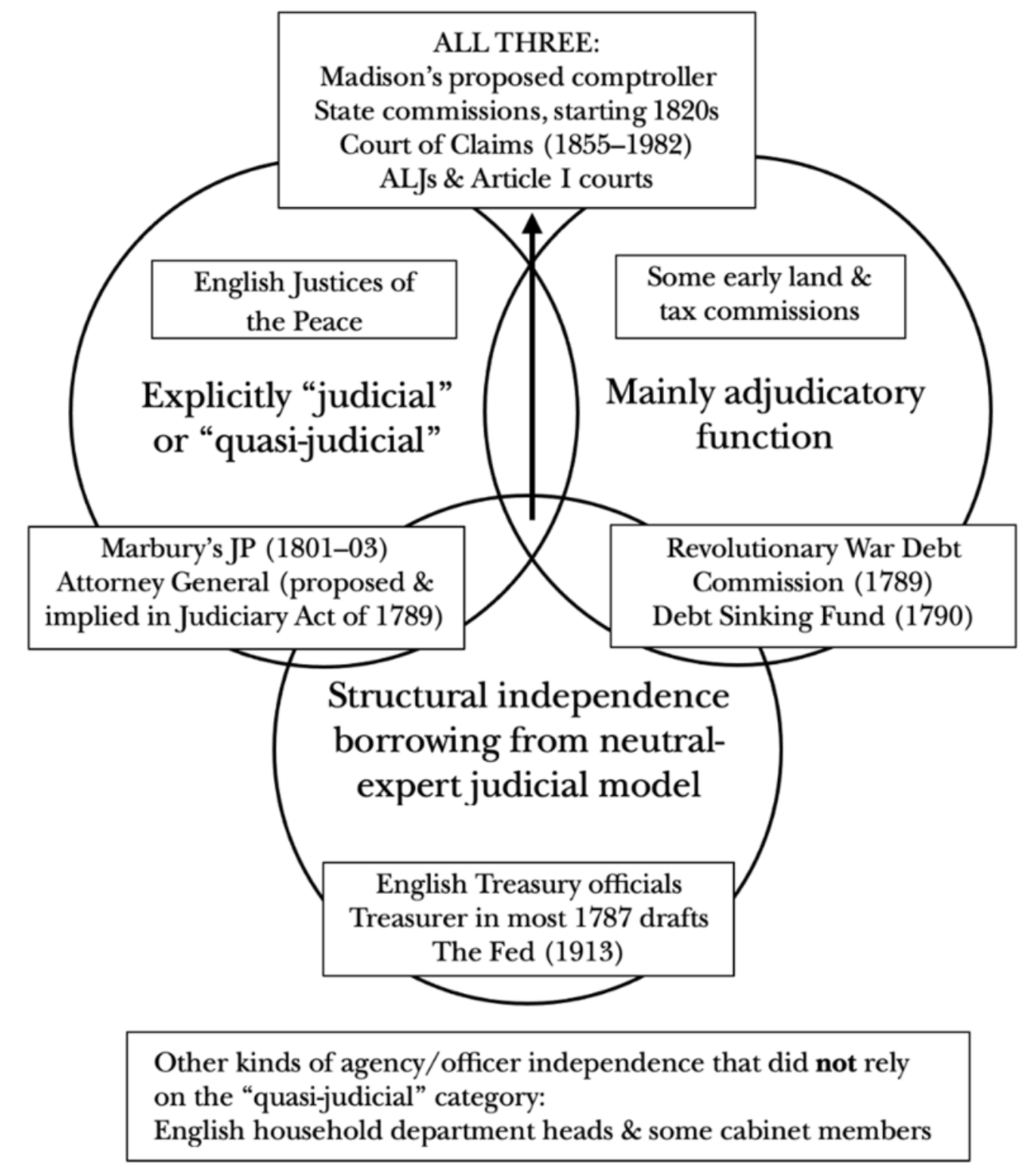
Within those two dimensions, we find three overlapping categories that constitute the “quasi-judicial” tradition as available for depth and insulation from political control: (1) executive offices that contemporaries identified as judicial or quasi-judicial or that contemporaries compared to judges; (2) executive offices with adjudicatory procedures, forms, and functions; and (3) offices granted structural independence borrowing from the neutral-expert judicial model.
Many offices that fell into some of these categories did not protect incumbent administrators from at-will removal. But, often at the same time, many other quasi-judicial administrators were protected from at-will removal.
41
See infra sections II.A.2–.B.
These cases constitute a tradition of case-by-case legislative discretion.
42
Cf. Wiener, 357 U.S. at 355 (“When Congress has for distribution among American claimants funds derived from foreign sources, it may proceed in different ways. Congress may appropriate directly; it may utilize the Executive; it may resort to the adjudicatory process.”).
They support the default rule in Wiener that such offices should be considered independent or insulated unless Congress explicitly said otherwise.
43Wiener concerned the attempted removal of a member of the War Claims Commission. Id. at 349–50. The Warren Court unanimously held that President Eisenhower’s attempted removal of that member was unlawful. Id. at 350, 356. The Commission was straightforwardly quasi-judicial in nature. See id. at 355 (describing the Commission’s role in adjudicating claims as having an “intrinsic judicial character”). But Congress did not provide the Commissioners with any statutory protection from removal. See id. at 350 (“This limit on the Commission’s life was the mode by which the tenure of the Commissioners was defined, and Congress made no provision for removal of a Commissioner.”); see also id. at 352 (reasoning that the lack of a removal provision was irrelevant because the case presented an issue in which inferences “must be drawn from congressional failure of explicitness”). The absence of a removal provision has led to multiple generations of criticism toward the Court’s holding in Wiener. See, e.g., Aditya Bamzai, Taft, Frankfurter, and the First Presidential For-Cause Removal, 52 U. Rich. L. Rev. 691, 744 (2018) (“[I]n Wiener, Justice Frankfurter’s opinion . . . pivoted almost 180 degrees from Chief Justice Taft’s opinion for the Court in Myers—inferring, as a matter of congressional intent, that quasi-judicial officers are presumptively removable only for cause even when a statute fails to include an express for-cause removal provision.”). This Article’s contribution makes sense of the Wiener decision and may justify a presumption against at-will removal for at least some quasi-judicial administrators.
This Article shows that Wiener’s default rule—and its legal intuitions about core domains of adjudicative independence—rest on a deep historical pedigree stretching from the English legal backdrop, through the Founding Era, to the New Deal.
Figure 1: Three Aspects of the Quasi-Judicial Category
44
Three aspects of the “quasi-judicial” category with some examples throughout Anglo-American history. See infra Part II for eighteenth-century and early nineteenth-century examples offered here; Part III for the twentieth-century examples offered here.
When Humphrey’s Executor used the language of “quasi-judicial” administration, it was not inventing a category from whole cloth.
45
See Baumann, Remembering Congress, supra note 17 (manuscript at 2, 4–5) (showing that the quasi categories were well established long before Humphrey’s Executor was decided).
Nor was it referring to a recent Progressive Era innovation. It was drawing on a longstanding vocabulary of institutional design.
English legal theorists and other European commentators highlighted England’s mixed constitution—especially the mixing of executive and judicial powers.
46
See infra section II.A.
Even after the Constitutional Convention had been debating and drafting for three months, Gouverneur Morris, one of the architects of Article II, was recorded stating that “the Judiciary . . . was part of the Executive.”
47
Notes of James Madison (Aug. 15, 1787) (statement of Gouverneur Morris), in 2 The Records of the Federal Convention of 1787, at 296, 299 (Max Farrand ed., 1911) [hereinafter Farrand’s Records]; see also infra section II.A.1.
The Ratification debates offered similar understandings.
48
See, e.g., Letter XV from the Federal Farmer to the Republican (Jan. 18, 1788), reprinted in 20 The Documentary History of the Ratification of the Constitution: Digital Edition 1043, 1043 (John P. Kaminski, Gaspare J. Saladino, Richard Leffler, Charles H. Schoenleber & Margaret A. Hogan eds., 2009), https://rotunda.upress.virginia.edu/founders/default.xqy?keys=RNCN-print-02-20-02-0004-0139 (on file with the Columbia Law Review) (“The business of the judicial department is, properly speaking, judicial in part, in part executive, done by judges and juries, by certain . . . executive officers, as clerks, sheriffs, &c. they are all properly limbs, or parts, of the judicial courts, and . . . faithfully . . . decide upon, and execute the laws . . . .”).
They did not need a label like “quasi-judicial,” because the English had not separated executive and judicial power. This mix was the norm, not a special exception.
From seventeenth-century England through the Founding and the nineteenth century, lawmakers mixed administrative authority with judicial forms.
49
See infra Part II.
They created officers who settled accounts, adjudicated claims, administered public funds, supervised fiscal obligations, and resolved disputes through procedures associated with courts.
50
See infra Part II.
These officials were not always independent. But the recurring association between judge-like functions and decisional neutrality shaped the way Anglo-American lawmakers understood administration.
Americans specified the Attorney General played such a judicial or “quasi-judicial” role in the late eighteenth century through the mid-nineteenth century. Remarkably, we can find this understanding in Thomas Jefferson’s writings that Chief Justice Roberts unwittingly cited in Slaughter for the opposite conclusions.
51
Contrast Thomas Jefferson, Notes Concerning the Right of Removal From Office (1780), in 4 The Papers of Thomas Jefferson 281, 281–82 (Julian P. Boyd ed., 1951) [hereinafter Jefferson’s Notes] (“[W]here the officers of government should have freehold [law] has declared they shall hold during good behavior. Judges—Register Clerks—Attorney General. Where not removable by Executive, reserved expressly to legislature or others.”), with Trump v. Slaughter, 146 S. Ct. 2283, 2295 (2026) (claiming that Jefferson understood executive officers to be removable by the President at will (quoting Jefferson’s Notes, supra, at 281)). For further discussion, see infra notes 247–253 and accompanying text.
The First Congress’s Judiciary Act of 1789 created the Office of the Attorney General as implicitly more independent from presidential control and removal, compared to the three department heads (Foreign Affairs, War, and Treasury) established earlier that year.
52
See Jed Handelsman Shugerman, The Creation of the Department of Justice: Professionalization Without Civil Rights or Civil Service, 66 Stan. L. Rev. 121, 129–31 (2014) [hereinafter Shugerman, DOJ] (contrasting the limited executive powers and signs that Congress envisioned having power over the Attorney General with the broader powers given to the three other positions composing the first cabinet); Jed H. Shugerman, The Indecisions of 1789: Inconstant Originalism and Strategic Ambiguity, 171 U. Pa. L. Rev. 753, 834–36, 844–46 (2023) [hereinafter Shugerman, Indecisions of 1789] (explaining that “the Judiciary Act’s specific use of ‘at pleasure’ for two low-level offices of law enforcement signals stronger protections for other officers in the Judiciary Act,” especially when compared with the removal provisions for other offices created in the summer of 1789); infra section II.C.
In the same context, Attorney General William Wirt described his office as akin to that of a “judge” in 1820,
53
Letter from William Wirt to John C. Calhoun, supra note 3, at 68.
followed by Attorney General Caleb Cushing specifically using the term “quasi judicial” in 1854 for the same purpose.
54
Office and Duties of Attorney General, 6 Op. Att’ys Gen. 326, 334, 352 (1854).
The term “quasi judicial” spread after the 1820s, including in a unanimous Supreme Court decision in 1849.
55
Wilkes v. Dinsman, 48 U.S. (7 How.) 89, 129 (1849); see also Nathaniel Wald Donahue, Officers at Common Law, 135 Yale L.J. 1887, 1958–66 (2026) [hereinafter Donahue, Officers]; Brief of Amici Curiae Legal Historians Noah A. Rosenblum and Nathaniel Donahue in Support of the Respondents at 16–17, Slaughter, 146 S. Ct. 2283 (No. 25-332), 2025 WL 3230468; infra section II.E.2.
The most obvious application of the quasi-judicial tradition is adjudication. Officials who decide claims, impose legal consequences, or resolve disputes through court-like procedures have long been understood to require some measure of decisional neutrality, which Congress has effectuated by instituting removal protection and other methods of insulation.
56
See Humphrey’s Ex’r v. United States, 295 U.S. 602, 603 (1935) (explaining that Congress can insulate quasi-legislative and quasi-judicial officers from presidential removal to preserve their independence from executive control and coercion), overruled by Slaughter, 146 S. Ct. 2283; see also Wiener v. United States, 357 U.S. 349, 353 (“[O]ne who holds his office only during the pleasure of another[] cannot be depended upon to maintain an attitude of independence against the latter’s will.” (internal quotation marks omitted) (quoting Humphrey’s, 295 U.S. at 629)).
That tradition is the core commitment preserved in Wiener.
57Wiener, 357 U.S. at 355.
But this Article also recovers a second and overlooked strand of the same tradition: money-related administration. Fiscal, monetary, tax, debt, banking, and public-accounting functions were repeatedly associated with judicial virtues.
58
See, e.g., 1 Annals of Cong. 611 (1789) (Joseph Gales ed., 1834) (statement of Rep. Madison) (advocating for a Comptroller of the Treasury that would possess “Judiciary qualit[ies]”).
Here, the work of scholars like Professor Christine Chabot, who has recovered the Founding Era Sinking Fund Commission, supplies an important foothold.
59
See Christine Kexel Chabot, Is the Federal Reserve Constitutional?: An Originalist Argument for Independent Agencies, 96 Notre Dame L. Rev. 1, 5 (2020) [hereinafter Chabot, The Fed] (noting that even Alexander Hamilton, a proponent of a muscular executive, sought administrative depth instead of presidential control when it came to the Sinking Fund Commission).
Lawmakers reached for judge-like forms and safeguards because sensitive financial authority seemed to require legality, impartiality, and insulation from ordinary political pressure.
60
See id. at 5–7.
That second strand matters after Cook. The Federal Reserve is not best understood merely as an anomaly flowing from the First and Second Banks of the United States.
61
See supra note 25 (collecting citations comparing the Fed and the Banks of the United States).
That portion of the Cook decision is erroneous.
62
See Menand, UET and the Fed, supra note 25, at 2114–21 (deconstructing the UET-exception arguments premised on the Banks of the United States).
The Fed is part of a broader tradition in which lawmakers treated money-related administration as especially vulnerable to political manipulation and therefore especially in need of institutional depth. From English Treasury and England’s other fiscal offices
63
Shugerman, Venality, supra note 33, at 258–67.
to the early American republic’s Sinking Fund Commission,
64
See Chabot, The Fed, supra note 59, at 3–5 (discussing the Founding Era Sinking Fund, “which conducted the same open market purchases of U.S. securities as today’s Open Market Committee” and describing the history of “the misuse of funds in England”).
debt commissions,
65
Christine Kexel Chabot, Interring the Unitary Executive, 98 Notre Dame L. Rev. 129, 160 (2022) [hereinafter Chabot, Interring]; Victoria Nourse, The History of Multi-Member Commissions at the Founding, 1789–1840: New Evidence on Independent Agencies, 76 Duke L.J. (forthcoming) (manuscript at 5–14), https://ssrn.com/abstract=5628110 [https://perma.cc/SL92-VLT6] (discussing the Revolutionary War Debt Commission); id. (manuscript at 23–32) (discussing Founding Era commissions dedicated to taxation and title).
and Madison’s proposed Comptroller,
66
See Shugerman, Indecisions of 1789, supra note 52, at 824–34.
to the Court of Claims in the 1850s,
67
See infra section II.E.5.
the Civil War era’s Comptroller of the Currency,
68
See infra notes 414–417 and accompanying text.
and eventually the Federal Reserve and administrative law judges,
69
See infra notes 572, 591 and accompanying text.
lawmakers have long worried that financial judgment and adjudication of claims could not safely be reduced to presidential preference. Cook recognizes that concern in the specific context of central banking.
70
See Trump v. Cook, 146 S. Ct. 2234, 2242–44 (2026) (discussing the unusual lengths to which different Congresses went in ensuring that monetary policy would be administered by figures ostensibly insulated from politics).
Our history shows that the concerns that led Congress to create a Federal Reserve defined by its depth run deep into the Anglo-American constitutional project.
This history also helps us better grapple with the world after Roberts’s elliptical opinions in Slaughter and Cook.
71
See Trump v. Slaughter, 146 S. Ct. 2283, 2305–06 (2026) (writing that the Court had “no occasion today to define the bounds of what [executive] power entails” and was “leav[ing] those questions” having to do with “‘non-Article III courts’ . . . for another day” (quoting Transcript of Oral Argument, supra note 22, at 15, 28)); Cook, 146 S. Ct. at 2249 (declining to “fully demarcate the contours of ‘cause’”). One of us (Shugerman) thinks the Slaughter Court could have crafted a more historically legitimate rule by holding more narrowly that the modern FTC, circa 2026, exercises traditional executive enforcement powers that go beyond the kinds of quasi-legislative or quasi-judicial powers that Congress delegated in 1914. On this point, see Daniel A. Crane, Debunking Humphrey’s Executor, 83 Geo. Wash. L. Rev. 1835, 1851–68 (2015) (discussing the development of the FTC as taking on an increasingly executive character since it was established in 1914); Eli Nachmany, The Original FTC, 77 Ala. L. Rev. 1, 54–56 (2025) (arguing that the modern FTC has expanded powers and functions so that the agency is no longer covered by the decision in Humphrey’s Executor). Such a decision would have retained Humphrey’s Executor as a precedent—correctly as a matter of law and history—while also holding that the FTC had aggregated or accumulated more traditional executive powers over the past century. In other words, the FTC of 1926 could be independent in its mix of quasi-legislative and quasi-judicial powers, but arguably, the FTC of 2026 was no longer valid under Humphrey’s.
Among other open questions, Chief Justice Roberts acknowledged the possibility of tenure protections for “non-Article III courts” and for commissions that “influenced monetary policy,” following the tradition of early Congress.
72Slaughter, 146 S. Ct. at 2306. Note the broader reference to “non-Article III courts,” instead of the conventional, narrower label “Article I courts.” Id. This perhaps signals a hint of openness to removal protections for Article II adjudicators, especially if they are not principal officers (for example, administrative law judges, administrative patent judges, and adjudicatory commissions). Strangely, the Slaughter majority did not focus in on the usual distinction between principal and inferior officers. Contrast id. at 2301 (referring to “inferior officers” only one time in the majority opinion), with, e.g., Seila Law LLC v. CFPB, 140 S. Ct. 2183, 2199–2200 & n.3 (2020) (analyzing the distinction at length), and Ilan Wurman, The Original Presidency: A Conception of Administrative Control, 16 J. Legal Analysis 26, 29–30 (2024) (arguing that the President can remove, but not directly control, principal officers, and inversely, that Congress may insulate inferior officers from removal but not directly control them). Concurring, Justice Neil Gorsuch emphasized presidential removal power over even principal officers. See Slaughter, 146 S. Ct. at 2311, 2319 (Gorsuch, J., concurring). Chief Justice Roberts, meanwhile, led his textual analysis with the Appointments Clause’s provisions on principal officers. Id. at 2293–96 (majority opinion). This inference is contradicted by the text and the historical record, but taken on its own, this Appointments Clause argument leaves more flexibility for Congress to treat inferior officers and employees differently, because there is no guarantee of presidential nomination, and it grants more discretion to Congress. See U.S. Const. art. II, § 2 (giving Congress discretion to grant the President appointment power only for “inferior Officers”). One day after Slaughter, the Roberts Court notably left in place the injunction protecting the Register of Copyrights and Director of the U.S. Copyright Office, whose duties include adjudication and rulemaking. See Blanche v. Perlmutter, 146 S. Ct. 2812, 2812 (2026) (mem.); Overview, U.S. Copyright Off., https://www.copyright.gov/about/ [https://perma.cc/HPS3-DSCW] (last visited Aug. 11, 2026).
It was wise to leave those categories for another day; but when that day comes, the Supreme Court should reaffirm their independence broadly.
Our history demonstrates that Humphrey’s Executor was right as a matter of history and tradition. But even though Slaughter has now overturned Humphrey’s,
73Slaughter, 146 S. Ct. at 2302.
it does not follow that the quasi-judicial tradition is empty. The mistake of Humphrey’s Executor was not that it invoked quasi-judicial administration but that it used the quasi-judicial label without establishing it as a coherent tradition with legal principles. The Humphrey’s Court leaned on that category to do too much work. Properly understood, the category does not authorize a general fourth branch. The quasi-judicial tradition is narrower. It allows Congress to protect administrative impartiality when political control might undermine good government.
The post-Slaughter world requires a limiting principle. The UET offers a deeply unappealing one: If an officer executes law, the President must be able to remove that officer at will.
74
See id. at 2297.
That principle is overly formalistic and at odds with American history. Anglo-American lawmakers have long created officials who execute law while acting in judge-like ways, and they have sometimes insulated those officials when independence was deemed necessary to the office. The better principle is one of congressional discretion.
75
Both Authors agree that congressional discretion is rooted in the Necessary and Proper Clause of Article I. See U.S. Const. art. I, § 8, cl. 18; Jed Handelsman Shugerman & Gary Lawson, Presidential Removal as Article I, Not Article II, 121 Nw. U. L. Rev. (forthcoming 2026) (manuscript at 21–24), https://ssrn.com/abstract=5736583 [https://perma.cc/P98J-GET3] (rooting the authors’ analysis in Article I); Baumann, Appointments Clause, supra note 37 (making a similar argument). Shugerman and Lawson suggest that early legislative precedents—as well as the term “proper” in the Necessary and Proper Clause—limit congressional discretion to set removal conditions or grant life tenure to executive officers. See Shugerman & Lawson, supra (manuscript at 55–56) (explaining that double layers of independent commissions could be understood as an excessive diffusion of accountability that improperly hinders presidential control; and a single head is more likely to clash with a President and hinder a President’s policy goals than a multi-member commission with staggered (and often bipartisan) terms). Baumann would not use the precedents in question to narrow Congress’s ongoing ability to innovate. Cf. Leah M. Litman, Debunking Antinovelty, 66 Duke L.J. 1407, 1412 (2017) (criticizing an approach to federal statutes that unduly squeezes Congress’s ability to innovate). He sees in the quasi categories a broad power that is only meant to be checked, in most all cases, through the political process. See Nikolas Bowie & Daphna Renan, The Separation-of-Powers Counterrevolution, 131 Yale L.J. 2020, 2024–27 (2022) (comparing a “republican” separation-of-powers paradigm from the Founding with a “juristocratic” alternative).
Congress may insulate adjudicatory, fiscal, monetary, or otherwise judge-like administration to prevent hierarchical political control. Our ongoing project shows that the quasi-judicial tradition is not necessary for depth, insulation, and removal protections like cause. It is not the only grounds for such discretion. In a forthcoming paper, we will explain that the quasi-legislative category has a pedigree (a history and tradition) for legislative discretion to insulate, too.
76
See Beau J. Baumann & Jed Shugerman, Quasi-Legislative: A History and Tradition (unpublished manuscript) (on file with the authors).
This Article proceeds in four Parts. Part I sketches the overarching interpretive method of the quasi-judicial tradition by juxtaposing it against the falling pillars of the UET and situates the argument in the wake of Slaughter and Cook. It argues that, despite the Court’s overruling of Humphrey’s Executor in Slaughter, Wiener remains central. And that centrality is only reinforced by Cook’s demand for a history-and-tradition analysis.
Part II reconstructs the early history of the quasi-judicial tradition in Anglo-American jurisprudence. It shows that early modern English and early American lawmakers were operating off of theories of administration that are inconsistent with a simplified vision of presidential command. Instead, lawmakers created administrators who, through procedures, norms, and institutional forms, mimicked courts.
Part III explores the tradition’s evolution across the nineteenth and twentieth centuries. All three branches of government used the idea of a quasi-judicial tradition to describe officials who resolved disputes, regulated money, and performed other tasks that mimicked courts.
Part IV focuses on the present; it argues that the quasi-judicial tradition supplies an account of what ought to survive Slaughter. The tradition does not give us a general permit for independent agencies. Instead, it fleshes out Cook’s emphasis on history and tradition. Because of the history we provide, the Cook exception to Slaughter’s unitarian dictate requires that the Court recognize that Congress possesses considerable discretion to build administrative depth around quasi-judicial administrators. Separately, this tradition provides a frontal repudiation of the UET’s maximal pretensions.
We anticipate that some may suggest that we are merely historicizing the old Humphrey’s Executor regime in an attempted counterrevolution. To the contrary, we think Humphrey’s was a deeply flawed opinion, relying more on simplistic labels than analysis or history—thus sowing its own demise.
77
One of the greatest constitutional commentators, Edward Corwin, nailed the problem with Humphrey’s almost immediately, and it had nothing to do with the validity or pedigree of the quasi categories. After referencing the quasi categories, Justice George Sutherland wrote mysterious sections that seemed to indicate that the FTC was not an Article II entity at all. See, e.g., Humphrey’s Ex’r v. United States, 295 U.S. 602, 628 (1935) (“The [FTC] is an administrative body created by Congress to carry into effect legislative policies . . . and to perform other specified duties as a legislative or as a judicial aid. Such a body cannot in any proper sense be characterized as an arm or an eye of the executive.”), overruled by Slaughter, 146 S. Ct. 2283. Corwin correctly spotted the conceptual disaster of Humphrey’s. Where could this agency created to execute the law exist if not in Article II? Asking in a mocking tone, “where is [the FTC commissioner]?”, Corwin continued, “is he, forsooth, in the uncomfortable halfway condition of Mahomet’s coffin, hovering ’twixt Heaven and Earth?” Edward S. Corwin, The President: Office and Powers: History and Analysis of Practice and Opinion 94 (1940).
Justice George Sutherland did not understand the quasi categories he wielded. He lacked any sophisticated understanding of these concepts and the historical developments they stood for.
78
See Humphrey’s, 295 U.S. at 624, 628–29 (failing to acknowledge the historical roots of the quasi-judicial concept).
The Slaughter Court may see itself as the antithesis of Justice Sutherland in Humphrey’s, but it mirrors his mistakes in dismissing the history behind the quasi-judicial category. While the Roberts Court’s cherry-picking approach to history in Slaughter leads to a maximalist interpretation of Article II with no apparent room for exceptions, the majority is obviously unwilling to follow its own textual logic for the Fed in Cook,
79
See infra notes 591–594 and accompanying text.
and leaves itself an awkward escape clause toward the end of Slaughter.
80
See Slaughter, 146 S. Ct. at 2306 (leaving open “the possibility that some functions traditionally handled outside the Executive Branch may not be encompassed by Myers’s general rule”).
The Roberts Court does not offer itself or lower courts much coherent guidance for applying the Slaughter–Cook conundrum to other offices. If we take the provisos from Slaughter and Cook seriously, if there are exceptions to the UET’s domain that are dictated by the history and traditions of the Anglo-American constitutional project, then the quasi-judicial tradition should be inevitable.
Humphrey’s old quasi-judicial category is dead . . . long live the new Slaughter–Cook quasi-judicial category.
81
The royalist reference here is intentional. The Roberts Court has implicitly relied on royal practice for its historical claims that “executive power” implied removal, and it repeated that assumption more explicitly in Slaughter. See, e.g., Free Enter. Fund v. Pub. Co. Acct. Oversight Bd., 561 U.S. 477, 492–93 (2010) (calling the removal power a “traditional” component of “executive power” that the Framers did not take away from the President and relying on the royalist assumptions of Myers v. United States, 272 U.S. 52 (1926), without restating them); Slaughter, 146 S. Ct. at 2291 (explicitly arguing that the Framers’ view of the President was informed by the royal powers of the King); see also Myers, 272 U.S. at 118 (“In the British system, the Crown . . . had the power of appointment and removal of executive officers, and it was natural, therefore, for those who framed our Constitution to regard the words ‘executive power’ as including both.” (citing Ex parte Grossman, 267 U.S. 87, 110 (1925))). But Justice Sotomayor was correct in her dissent: “The powers held by the English Crown and state governors before ratification did not include a removal power that the legislature could not modify. Instead, Parliament often restricted the Crown’s ability to remove even high-level royal officers . . . .” Slaughter, 146 S. Ct. at 2327 & n.5 (Sotomayor, J., dissenting).